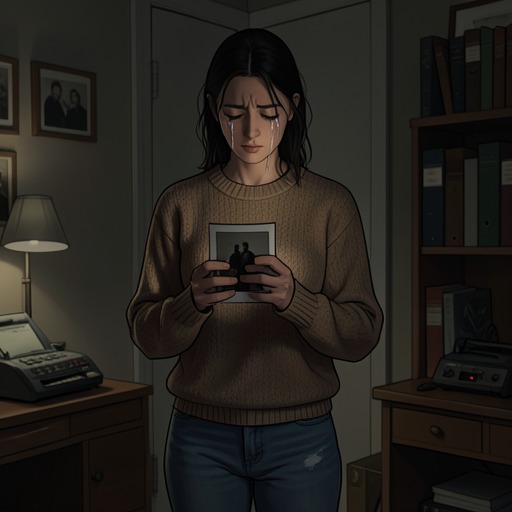
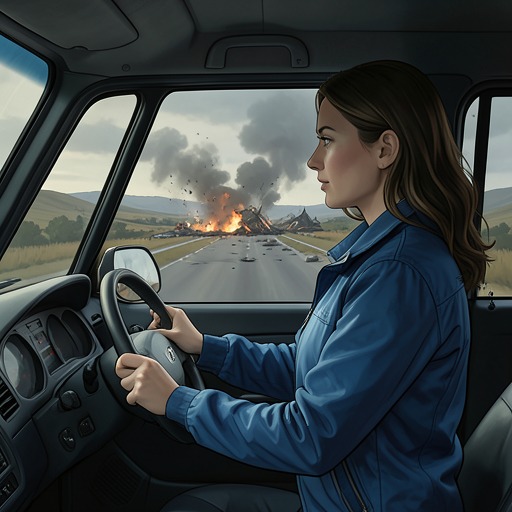
Violet Markey's fear of driving after the accident
All the Bright PlacesViolet Markey’s fear of driving after the accident turns the car into more than transportation: it is a place where grief can interrupt movement, and where returning to movement becomes a tentative act of recovery. For a year she does not drive. When she finally takes her mother’s car, her hands and feet are unsteady, Eleanor’s remembered presence rides beside her, and the drive ends not in a declared cure but at Theodore Finch’s home, reached under a false pretense.
The Accident and the Lost Routine
The accident changed Violet’s relation to driving as well as her family’s sense of what might be possible for her. Her mother later says that it took many things from them and that they had not known whether Violet would ever drive again. The words place her fear within a wider bereavement: driving is not presented as an isolated inconvenience but as one of the ordinary parts of life the accident disrupted. Her mother carefully qualifies the loss, acknowledging that driving is not the most important thing in life while insisting that a young person should not have to hesitate over it except to be careful.
A conversation with Finch shows how difficult the subject remains before Violet returns to the wheel. He asks her to tell him about the accident, and she begins with fragments: getting into the car as they left a party, and Eleanor’s argument with Eli Cross. The account begins in remembered particulars rather than a full reconstruction. That limited recollection gives the accident a narrative presence without making Violet’s memory complete; the loss is understood through what she can say and through the life that has changed afterward.
A Year Away from the Wheel
Violet’s first return to driving begins on a snowy Wednesday after she has gone a day, then two, then three without hearing from Finch. She has wiped out several times riding Leroy on the white roads, and asks her mother to borrow the car, saying she is going to Shelby Padgett’s house on the other side of town. The ease with which she gives that explanation surprises her. Her mother, however, understands the magnitude of the request: she stares, hands over the keys, and follows Violet down the sidewalk, crying as she goes.
Violet answers her mother’s emotion with an embrace, then climbs into the driver’s seat and performs confidence in small, visible gestures. She waves, smiles, starts the engine, and says aloud that she is ready. As she pulls away slowly, she continues waving and smiling, but privately questions what she is doing. The contrast matters: the outward signs reassure her mother, while Violet’s uncertainty remains active beneath them. The drive is not effortless simply because she has started it.
Eleanor in the Passenger Seat
At first Violet is shaky and keeps hitting the brakes, jolting herself as she tries to manage a skill she once possessed. Her recovery of the driving routine arrives through a memory of Eleanor after Violet got her license. Eleanor had imagined Violet as her chauffeur, with herself sitting in the back, putting her feet up and enjoying the view. The memory restores the sisters’ familiar playfulness to a situation otherwise dominated by absence.
Violet looks toward the passenger seat and almost sees Eleanor there: leaning against the door, knees drawn up, laughing or singing along, trusting Violet to drive without watching the road. The imagined passenger does not erase the fear or return Eleanor to the car in any literal sense. Instead, the memory gives Violet a way to inhabit the seat and continue. By the time she reaches Theodore Finch’s neighborhood, she is driving smoothly, as if she had been doing it for years. The change from repeated braking to steady motion is a concrete measure of regained capacity, though it does not establish that grief or fear has vanished.
The Drive’s Real Destination
The stated destination, Shelby’s house, conceals Violet’s actual purpose: she is driving to see Finch. The lie weighs on her precisely because her mother’s tears make the return to driving feel momentous. Violet recognizes her mother’s happiness and feels worse for having misled her. The scene therefore binds two kinds of exposure together: she has made herself visible as someone willing to drive again, but not yet as someone acting on her worry about Finch.
At Finch’s home, Violet meets Mrs. Finch for the first time. She introduces herself by name and says she has come to see Finch; the exchange reveals how far the relationship has developed while Violet has remained unknown to his mother. Mrs. Finch expects her son to be home from school, unaware that he has been expelled, while Violet arrives with knowledge of his situation and concern sharpened by his unanswered messages. Driving has carried Violet across town and into a more direct encounter with Finch’s family, even as the reason she gave her mother remains concealed.
Recovery Without a Simple Resolution
The episode does not frame recovery as the sudden disappearance of fear. Violet is still shaky, brakes too often, doubts herself, and lies about where she is going. Yet she asks for the keys, accepts her mother’s trust, remembers Eleanor without stopping the drive, and makes it to Finch’s neighborhood under her own control. The sequence gives her progress a practical form: the road is crossed one hesitant action at a time.
Driving also reconnects Violet to a future-oriented role she had once imagined with Eleanor. The old promise that she would be her sister’s chauffeur returns as a memory, but the present drive is undertaken alone, with Eleanor’s remembered trust rather than her physical company. Violet’s eventual smoothness carries both sides of that change: she can move forward again, while the person who once shared the imagined journey is still missing. Her return to driving is therefore neither a simple triumph nor a completed recovery, but a small, consequential resumption of agency inside continuing grief.